It's been a long time since I made a blog post, and in the spirit of the upcoming NBA Finals between the Boston Celtics and the Los Angeles Lakers I have been researching basketball history for a relevant mega-post. However, I couldn't help but notice some interesting chemistry between the Phoenix Suns' Slovenian Point Guard Goran Dragic and the Los Angeles Lakers' Slovenian Shooting Guard Sasha Vujacic. Apparently, these two countrymen don't like each other.
Some amusing online articles about the Slovenian rivals:
Goran Dragic and Sasha Vujacic Star in the NBA's Most Hilarious Rivalry.
Surprisingly, Sasha Vujacic and Goran Dragic are not best friends.
The Slovenian rivalry between Goran Dragic and Sasha Vujacic.
By the way, I got those three articles using Google. And as for the seriousness of the rivalry, I suspect it's hyped up. But it's still totally amusing.
Slovenia is going to start World War III via the NBA Western Conference Finals. Calling it now.
Sunday, May 30, 2010

Thursday, May 6, 2010
May 9 - День Победы
For many people, May 9 is a very important day. In the United States, it is important because it is Mother's Day. However, for many others, May 9 is significant for a different reason. May 9 marks Victory Day: the day that Nazi Germany surrendered to the Soviet Union in the Second World War (Second Great War to Russians). For those of us born and raised in America, this may come as a surprise. The Germans surrendered to the Allied nations on May 7, not May 9. May 7 is what we commonly refer to as VE Day, or Victory in Europe. The reason the Germans did not surrender to the Soviet Union at the same time was because when the Germans surrendered on May 7, Joseph Stalin was frustrated with the lack of a Soviet envoy at the treaty-signing. Believing that the Soviet Union deserved more attention for bearing the brunt of Germany's attacks during World War II, Stalin insisted on having a Soviet-run ceremony for Germany's surrender a day and a half later. Thus, the former member states of the Soviet Union celebrate Victory Day on May 9.
Some related facts:
* The Soviet Union mobilized 20 million soldiers during the course of the war. In comparison, the United States and Germany each mobilized approximately 11 million soldiers, and Japan mobilized less than 8 million.
* Over 14 million of the Soviet Union's soldiers lost their lives during the conflict. Germany had the second highest military death toll at under 3 million.
* Although the data is inconclusive, rough estimates put Soviet civilian casualties from 7 to 14 million people. Only China can claim a comparable number, ranging from 7 to 16 million civilian lives lost during the war.
* Scholars from all over the world commonly consider the Soviet counteroffensive at the Battle of Stalingrad in November 1942 (corresponding to the Allied offensive in North Africa) to be the major turning point of World War II. Both the Soviets and the Axis powers (Germany, Italy, Romania, and Hungary) lost approximately 1.1 million soldiers in that battle alone.
Sources:
1. World History Atlas, edited by Jeremy Black.
2. Encyclopedia Britannica, Battle of Stalingrad.
3. My Calculus teacher, born and raised in Soviet Russia.
Some related facts:
* The Soviet Union mobilized 20 million soldiers during the course of the war. In comparison, the United States and Germany each mobilized approximately 11 million soldiers, and Japan mobilized less than 8 million.
* Over 14 million of the Soviet Union's soldiers lost their lives during the conflict. Germany had the second highest military death toll at under 3 million.
* Although the data is inconclusive, rough estimates put Soviet civilian casualties from 7 to 14 million people. Only China can claim a comparable number, ranging from 7 to 16 million civilian lives lost during the war.
* Scholars from all over the world commonly consider the Soviet counteroffensive at the Battle of Stalingrad in November 1942 (corresponding to the Allied offensive in North Africa) to be the major turning point of World War II. Both the Soviets and the Axis powers (Germany, Italy, Romania, and Hungary) lost approximately 1.1 million soldiers in that battle alone.
Sources:
1. World History Atlas, edited by Jeremy Black.
2. Encyclopedia Britannica, Battle of Stalingrad.
3. My Calculus teacher, born and raised in Soviet Russia.
Sunday, May 2, 2010
This is the Story of a Yurt
In response to an innocent question in a game of online scrabble, I am now prepared to post about the mysterious Yurt. A Yurt is portable, like a tent, but much more durable than typical tents. It is a favorite form of housing for nomads and the Turks of Central Asia. To illustrate what a Yurt is, here are two excerpts from the manga Otoyomegatari (read right to left):


The dwellings in the above pages are Yurts. However, I did not learn of Yurts from a manga. I learned about them when I was in middle school, playing a computer game called Age of Empires. In the game, you can create maps and scenarios using various items and units. Among the items were dwellings, some of which were named Yurts. From there, I learned that Yurts were for nomads, but it would not be until I started studying history for fun that I became familiar with them.
So, now you know.
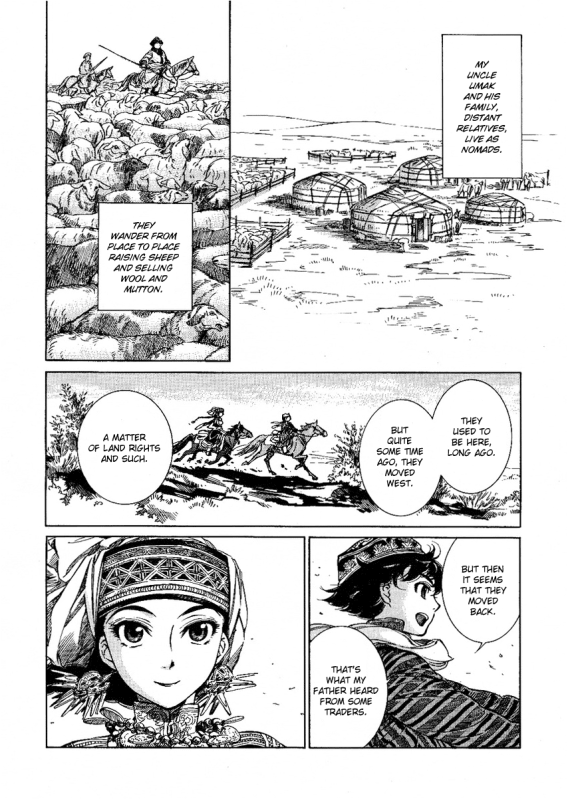
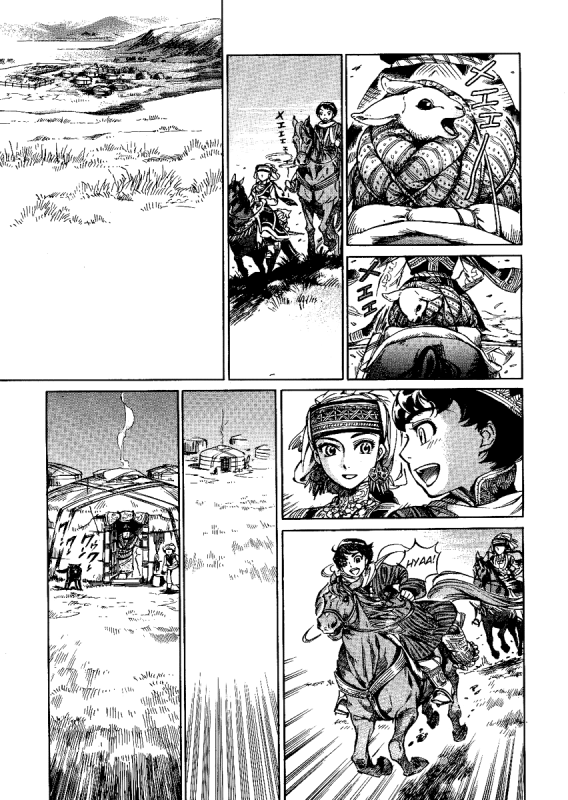
The dwellings in the above pages are Yurts. However, I did not learn of Yurts from a manga. I learned about them when I was in middle school, playing a computer game called Age of Empires. In the game, you can create maps and scenarios using various items and units. Among the items were dwellings, some of which were named Yurts. From there, I learned that Yurts were for nomads, but it would not be until I started studying history for fun that I became familiar with them.
So, now you know.
Wednesday, April 28, 2010
2010 NFL Draft: San Francisco 49ers

I know I'm a little late, but I really want to post about the 49ers' selections in the draft this year. I can hardly contain my excitement. Last year we had a good defense anchored by superstar linebacker Patrick Willis and a lot of weapons on offense, including Pro-Bowlers Frank Gore and Vernon Davis, and the rookie standout Michael Crabtree. With Singletary in his first full year as head coach, the 49ers fought hard for their first non-losing season since 2002. However, there were some obvious weaknesses. Luckily, we went into the 2010 NFL draft with two first round picks and several other good picks.
Before the draft, the team's biggest position needs were clearly spelled out: offensive linemen and defensive backs. Because the 49ers' old general manager has been removed from the organization, and a new one hasn't been hired yet, a former subordinate of the old GM stepped in to take the lead. I have a strong suspicion that Coach Singletary had a lot more influence over the draft as a result of this internal shakeup. Regardless of who was ultimately calling the shots, the 49ers definitely struck gold this time.
For the two first round picks San Francisco selected two offensive linemen: Anthony Davis from Rutgers and Mike Iupati from Idaho. Mike Iupati in particular is a happy site for me: he's 6'6", 330 lbs., and he's an American Samoan. So far, American Samoans in the NFL have proven to be both physically gifted and full of work ethic. I expect great things from him. If all goes according to plan, you will be seeing Davis and Iupati wearing jerseys #76 and #77 on the starting offensive line in game 1 against the Seattle Seahawks.
However, the 49ers didn't just get it right in the first round. They continued to make strong picks during the rest of the draft. Safety Taylor Mays is a huge steal, considering how physically gifted he is compared to many other defensive backs in this draft. He should fit right in with Coach Singletary's defensive style, and Taylor Mays is really happy about the situation too. When both the coach and the player are excited about working together, you can expect some great results on the field.
Linebacker Navorro Bowman doesn't quite fit the position need I had in mind at this point in the draft (I would've liked a defensive tackle or another defensive back),. He's a pass rushing linebacker, but it's still uncertain whether he'll fit into the 3-4 defense as an outside or inside linebacker. Furthermore, he has a lot of talented teammates playing the same/similar positions: Parys Haralson, Manny Lawson, Takeo Spikes, and of course, Patrick Willis. He brings depth at least, and his presence may inspire Manny Lawson to play harder. In terms of pure physical talent, Lawson should be better, but talent alone isn't enough. Maybe Bowman will spark a fire in Lawson?
The last pick I want to talk about is running back Anthony Dixon, drafted in the sixth round. With a draft lasting seven rounds, you typically don't expect to get much out of the sixth round. However, I really like San Francisco's selection here. Anthony Dixon is a great power back who was projected to go in the third or fourth round of the draft before draft day. Now, to be clear, Frank Gore is definitely our starting running back. But he can't be on the field all the time. Most running backs in the modern NFL destroy their legs (and their careers) if they are forced to be the every-down starting running back for eight or more years. So, Gore needs help. Last year we got Glen Coffee to provide it, but I wasn't impressed. I'm hoping Anthony Dixon can compete with Coffee to share the carries with Gore. In doing so, we extend the useful life of our best running back for several more years.
All in all, I think this was a very successful draft for the San Francisco 49ers. I'm looking forward to Coach Singletary's second full year leading this talented team. Given how weak the NFC West Division is, I expect the Red and Gold to go to the playoffs at least.
Sunday, April 25, 2010
Liar Game
I read a lot of Japanese manga, and most of it is pretty terrible. But sometimes I come across a real gem, and those rare stories are what drive me to continue reading manga. One of those gems is Liar Game.
The main characters of Liar Game couldn't be more different. One is a "foolishly honest" college student who is easily tricked, and the other is a genius ex-convict who drove a multi-level marketing group to bankruptcy. This unlikely pair gets dragged into a tournament-style contest run by the mysterious Liar Game corporation. As the name implies, the point of the game is to lie, and the winner stands to win huge amounts of money. The losers, on the other hand, go into debt.
The Liar Game consists of multiple rounds, and each round is a different type of game. One round is called "Minority Rule," where everyone is given a yes-or-no question, and in order to win, you have to always vote with the minority. Another round is a harmless version of "Russian Roulette," which requires more strategy than luck. How the participants use psychology to achieve victory is absolutely fascinating. It's a great story.
Furthermore, there are a wide variety of supporting characters. Many people with different backgrounds, ages, genders, personalities, and motivations help show how different people react to intense situations.
Unfortunately, the art is below average. It's enough to get the job done, which is to make you pay more attention to the story and the characters. There's nothing to distract you from the dialogue.
Liar Game chapters are available here until it is licensed for American release, at which point it may or may not be removed.
The main characters of Liar Game couldn't be more different. One is a "foolishly honest" college student who is easily tricked, and the other is a genius ex-convict who drove a multi-level marketing group to bankruptcy. This unlikely pair gets dragged into a tournament-style contest run by the mysterious Liar Game corporation. As the name implies, the point of the game is to lie, and the winner stands to win huge amounts of money. The losers, on the other hand, go into debt.
The Liar Game consists of multiple rounds, and each round is a different type of game. One round is called "Minority Rule," where everyone is given a yes-or-no question, and in order to win, you have to always vote with the minority. Another round is a harmless version of "Russian Roulette," which requires more strategy than luck. How the participants use psychology to achieve victory is absolutely fascinating. It's a great story.
Furthermore, there are a wide variety of supporting characters. Many people with different backgrounds, ages, genders, personalities, and motivations help show how different people react to intense situations.
Unfortunately, the art is below average. It's enough to get the job done, which is to make you pay more attention to the story and the characters. There's nothing to distract you from the dialogue.
Liar Game chapters are available here until it is licensed for American release, at which point it may or may not be removed.
Saturday, April 17, 2010
The Cheetah
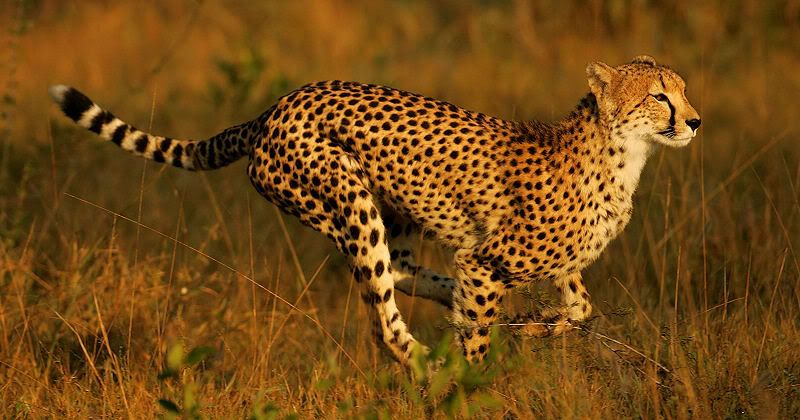
I have loved watching and reading about animals since I was a little kid. I especially enjoy the big cats of Asia and Africa: Tigers, Lions, Leopards, and Cheetahs. Even their canine counterparts (Wolves, Hyenas, African Hunting Dogs), whom I also enjoy watching, can not command as much of my attention as the big cats.
That said, it is pretty clear that the big cats are not created equal. The Leopard lives on more continents than any other big cat, making it the king/queen of adaptation. Lions are the second most successful big cat in Africa, with their pack behavior, large size, and the tourist industry giving them a definite edge against other predators. Leopards and Lions are thriving, or at least surviving, in the modern world.
Tigers are struggling in Asia, but only because of human encroachment. The small efforts made towards preserving Tiger populations show signs of success, but it is ultimately up to the people of India and China to adopt the African attitude. The sooner they start to see Tigers as a rich tourist attraction instead of as an annoyance or a threat, the better it will be for the Tiger population. In a way, one can think of "looking cool" as the Tiger's most valuable survival trait in the modern world. They also need to be able to tolerate human presence. Most Lions in Africa do not mind resting a short distance away from a bunch of humans in a vehicle. If Tigers can behave similarly, they will survive.
This just leaves us with the Cheetah. The smallest of the four big cats I mentioned, the Cheetah is also struggling to survive. 100 years ago there were an estimated 100,000 Cheetahs, while today the number is closer to approximately 10,000. Cheetahs used to range across the wild plains of Europe and India, but now you would be hard-pressed to find any living in either region outside of zoos. Due to their physical attributes and hunting behavior, they can only survive in wide open plains (such as the African savanna), and humans absolutely love to build in flat, open terrain.
Yet, the declining Cheetah population is not just due to humans encroaching on their habitats or hunting them. The Cheetah itself has many traits which make it difficult to adapt. Most noticeably, it is a beast specializing in speed. It can accelerate from 0 to 40 miles per hour in just three strides, and it can sprint up to a top speed of 70 miles per hour. It travels faster than the speed limit of a California highway. This makes it an extremely effective hunter of fast prey in the open savanna.
However, the physical characteristics that help it reach such high speeds are also what contribute to its lack of adaptability in the modern world. Because of its small head, it has weak jaws, so it has to kill its prey using suffocation. Its legs are too slim to use for brawling like a Lion or Leopard. As for its claws, because the Cheetah can not retract them, it can not keep them sharp. The blunt claws can only provide traction while running and perhaps help trip up prey. The Cheetah's greatest weapon is speed, and it can easily lose that speed if it is injured. This is an animal that simply isn't designed to fight. That's a shame, in part because almost all of the prey animals in Africa are great fighters. The only prey a Cheetah can safely hunt without risk of fatal injury are Antelopes such as Gazelle and Impala.
The Cheetah also has another unfortunate physical trait designed to help its speed: a lack of body fat. Unlike most predators, the Cheetah has no stored fat to help it survive in lean times. Even after it is full from a successful kill, the Cheetah would only have enough energy for perhaps three more hunts. In other words, if it fails to catch any prey in three hunts, it would begin to starve to death. Imagine all the basketball players who miss three shots in a row, or football quarterbacks who throw three consecutive incomplete passes. Those are the odds the Cheetah faces when it hunts.
Furthermore, it is not enough for the Cheetah to catch and kill its prey. Even after expending all that energy to catch a Gazelle or Impala, it still has to keep some in reserve to run away when a bigger predator (such as a Lion or Hyena) arrives to steal the prized meat. Cheetahs can not afford to get injured in a fight, especially against a larger foe, so they always prefer to flee at the sign of trouble. Unfortunately, they can not do that with their meal in tow, so the Cheetah could still end up starving after a successful hunt.
As difficult as hunting is for Cheetahs, the biggest threat to the Cheetah population is in reproduction. Genetic studies have revealed that Cheetahs lack genetic variety due to inbreeding. This has led to a lot of problems with Cheetah cubs and a high infant mortality rate. Even breeding Cheetahs in captivity has failed to produce better results.
On top of the genetic uniformity and weaknesses associated with inbreeding, Cheetah cubs are also very susceptible to being killed by other predators. Lions, Leopards, Hyenas, and even Eagles will take a bite out of a small Cheetah cub if given the chance. If, through a combination of effort and luck, a Cheetah cub survives to adulthood, it is still not an adept hunter by the time its mother abandons it. A young adult Cheetah still has a lot to learn through trial and error, and just one injury from a bad hunt or a fight with another predator will kill the Cheetah's chances for survival.
The most successful litter of cubs I have ever seen is one that hunted as a group after their mother abandoned them. They were four brothers who were raised by an experienced mom. Usually, young Cheetah mothers fail to keep all but one or none of their cubs alive. Experienced mothers are more successful on average, but keeping four cubs alive to adulthood is still quite an accomplishment. Rather than go their separate ways, the four cubs stuck together, forming an impromptu same-sex pack.
Another animal that likes to do this is the extremely successful African Hunting Dog. African Hunting Dogs love to form a same-sex pack that eventually merges with an opposite-sex pack when they find each other. These packs are very tightly-knit groups and have no internal disorder. They cooperate very well, and succeed in approximately 80% of their hunts.
The four-pack of Cheetahs is much smaller than a pack of African Hunting Dogs, and they are not likely to find multiple female Cheetahs willing to live with them for more than a few days, but their success at hunting was very real. They made up for their lack of experience with coordination born from growing up together. I never did find out how they did in the long run, but it would be pretty cool if they remained a successful pack into old age (17 years for captive Cheetahs and about 10 years for wild Cheetahs).
But as I mentioned earlier, finding a large group of Cheetah cubs that live to adulthood is very rare, and there's no guarantee that they will survive even after they are abandoned by their mother. Cheetahs are too ultra-specialized in speed, and their lack of adaptability is not only making it hard on them in the wild, but it is proving a problem in captivity too. Many scientists and conservationists have tried and failed to make the captive Cheetah population stable. Right now, both the captive and wild populations are in decline.
It would be a shame if the fastest land animal in the world went extinct, and at least one Conservationist has devoted her life to preventing the Cheetah's extinction. Her name is Dr. Laurie Marker of the Cheetah Conservation Fund in Namibia. Dr. Laurie Marker works with the local government and local farmers to understand their needs and balance them with the needs of the endangered Cheetahs. One of the goals is to inspire locals to become Conservationists, and to provide education so that locals have a new understanding of the wildlife around them.
If Dr. Laurie Marker succeeds, the wild Cheetah might become an even greater success story than the Tigers in captivity and the Lions in the wildlife preserves.
Sources and Further Information:
African Wildlife Foundation: Cheetah
Wilflife Conservation Network: Cheetah
Cheetah.Org Fact Sheet
ABC News Blog: Cheetahs in the Wild
How Stuff Works: Cheetah Speed
Pictures of Cats: Cheetah Facts
Friday, April 9, 2010
A Slice of Japan's Economic Life
I'm going to start into a short monologue about Japan's economy in a few moments, but I want to direct you to a Japanese manga called Usagi Drop for now.
Usagi Drop, or Bunny Drop as it is known in English-speaking bookstores, is a slice of life manga about a 30-year-old bachelor, Daikichi, struggling to raise a 6-year-old orphan girl, Rin. That's the whole story in a nut-shell, but for some reason I found it to be a very interesting read. It doesn't have much to say on Japan's economy, but it is something worth looking into if you get the chance.
Another slice of life manga I read a while back is a really long one called Living Game. The art is a bit old-fashioned, and the story is dragged on for a while. I'm also not a big fan of the main characters, which tends to spoil a slice of life manga for me. Nonetheless, I found it interesting, because the fall of Japan's bubble economy (1986 to 1991) plays a huge role in Living Game's story.
Japan's bubble economy was one of overinflated real estate and stock prices, due in no small part to easily obtainable credit. That should sound familiar to a lot of folks, but unlike America, Japan's bubble economy collapsed as early as 1991. Japan has been in a deflationary spiral ever since. Since 1991, Japan's stock value has continued to plummet, and it reached an all-time low in 2008.
Here's a link to a Yahoo financial graph of the Nikkei 225, an index for Japan's stock market: Yahoo Graph of Nikkei 225. By default, the graph is on a logarithmic scale and only shows a few days. I changed it to start in 1984 and have a linear scale, which makes the rise and fall of Japan's bubble economy look more dramatic.
However, what is most disturbing to me regarding Japan's economic disruption is what it did to its government: almost nothing. Since 1955 to 2009 the Liberal Democratic Party has been the majority party in Japan's government. The LDP's stance on their economy is that it is a unique blend of socialism and capitalism, such that it can not be compared to any other economy, and that if a measurement seems to indicate something is wrong with Japan's economy, it means that there is something wrong with the measurement.
Still, even in rigid Japan, change is happening. The new Democratic Party of Japan, formed from merging four opponents of the Liberal Democratic Party, has taken control of the government. Time will tell if the DPJ takes the country in the right direction.
On a side-note, though, Japan's unemployment rate is fairly stable at under 4% right now. Although the stock values are still low and Japan is still in a deflationary spiral, one could argue that Japan's economy really is just fine. I'm not making that argument, though. :P
Usagi Drop, or Bunny Drop as it is known in English-speaking bookstores, is a slice of life manga about a 30-year-old bachelor, Daikichi, struggling to raise a 6-year-old orphan girl, Rin. That's the whole story in a nut-shell, but for some reason I found it to be a very interesting read. It doesn't have much to say on Japan's economy, but it is something worth looking into if you get the chance.
Another slice of life manga I read a while back is a really long one called Living Game. The art is a bit old-fashioned, and the story is dragged on for a while. I'm also not a big fan of the main characters, which tends to spoil a slice of life manga for me. Nonetheless, I found it interesting, because the fall of Japan's bubble economy (1986 to 1991) plays a huge role in Living Game's story.
Japan's bubble economy was one of overinflated real estate and stock prices, due in no small part to easily obtainable credit. That should sound familiar to a lot of folks, but unlike America, Japan's bubble economy collapsed as early as 1991. Japan has been in a deflationary spiral ever since. Since 1991, Japan's stock value has continued to plummet, and it reached an all-time low in 2008.
Here's a link to a Yahoo financial graph of the Nikkei 225, an index for Japan's stock market: Yahoo Graph of Nikkei 225. By default, the graph is on a logarithmic scale and only shows a few days. I changed it to start in 1984 and have a linear scale, which makes the rise and fall of Japan's bubble economy look more dramatic.
However, what is most disturbing to me regarding Japan's economic disruption is what it did to its government: almost nothing. Since 1955 to 2009 the Liberal Democratic Party has been the majority party in Japan's government. The LDP's stance on their economy is that it is a unique blend of socialism and capitalism, such that it can not be compared to any other economy, and that if a measurement seems to indicate something is wrong with Japan's economy, it means that there is something wrong with the measurement.
Still, even in rigid Japan, change is happening. The new Democratic Party of Japan, formed from merging four opponents of the Liberal Democratic Party, has taken control of the government. Time will tell if the DPJ takes the country in the right direction.
On a side-note, though, Japan's unemployment rate is fairly stable at under 4% right now. Although the stock values are still low and Japan is still in a deflationary spiral, one could argue that Japan's economy really is just fine. I'm not making that argument, though. :P
Subscribe to:
Posts (Atom)